
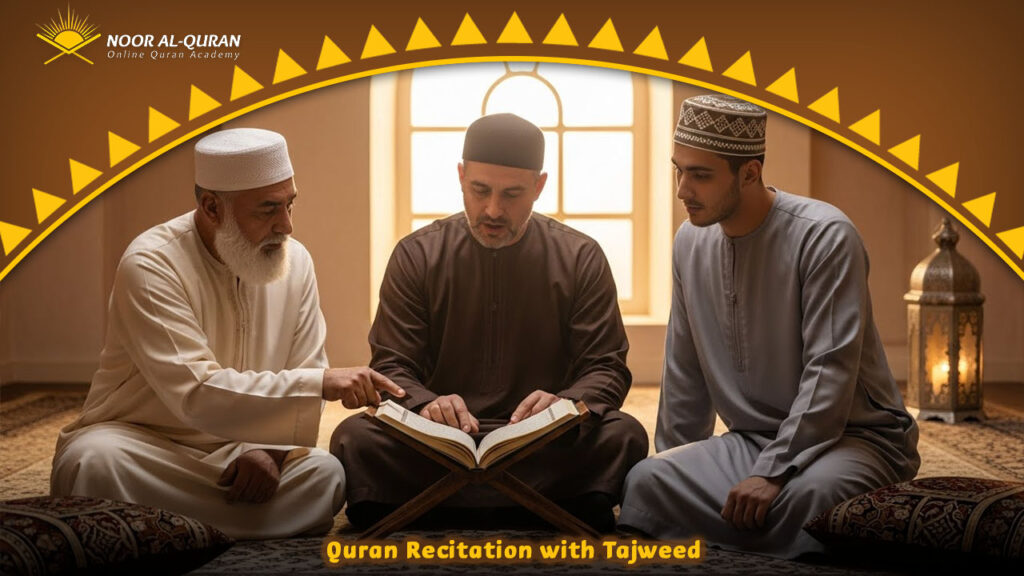
Quran Recitation with Tajweed at Online Quran Academy Noor Quran Academy offers students a unique opportunity to master the art of reciting the Holy Quran correctly. Our expert instructors provide step-by-step guidance, focusing on proper pronunciation, rhythm, and intonation.
Students of all ages can benefit from interactive lessons designed to build confidence and fluency. By combining traditional Tajweed rules with modern online teaching methods, learners achieve accurate recitation while enjoying a flexible and supportive learning environment. Whether you are a beginner or looking to refine your skills, our academy ensures a structured, engaging, and spiritually enriching experience for every student.
Tajweed Rules of the Quran: A Complete Guide
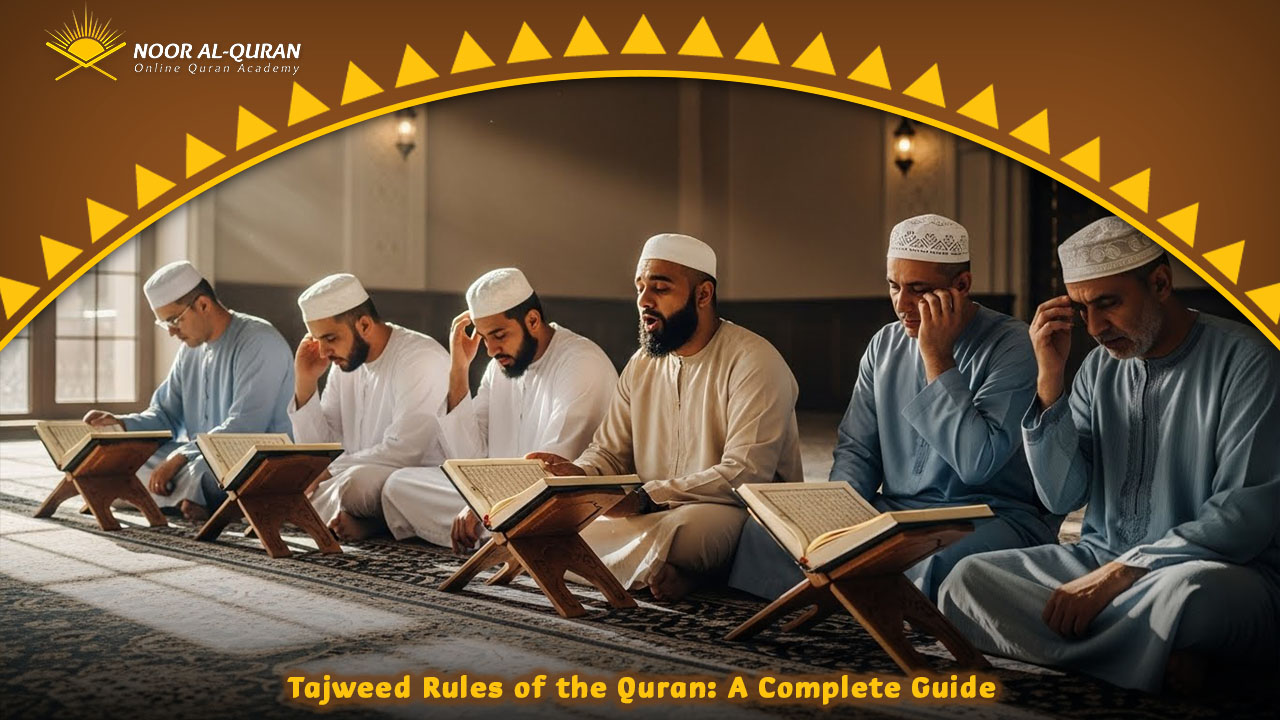
Tajweed is the science of correct Quranic recitation, derived from the Arabic root word “جَوَّدَ” meaning “to beautify” or “to improve.” It governs pronunciation, articulation, and intonation of Arabic letters while reciting the Quran. Mastering Tajweed ensures that the words of Allah are recited as revealed to Prophet Muhammad (PBUH), preserving their original meaning, rhythm, and spiritual impact.
Learning Tajweed helps students connect deeply with the Quran, respecting its sacredness and beauty. Noor Quran Academy provides structured courses for beginners and advanced learners, combining traditional rules with practical exercises for fluency and clarity.
Understanding Tajweed is not just a linguistic exercise; it is a spiritual practice that connects the reciter with the divine message of the Quran. Correct pronunciation enhances the beauty of the recitation and ensures that the meaning of each verse remains intact.
Tajweed teaches the nuances of Arabic phonetics, helping learners recognize subtle differences between letters that may seem similar to non-native speakers. For example, letters like ص (Saad) and س (Seen) have distinct articulation points, and mastering these differences is key to accurate recitation. Noor Quran Academy emphasizes both theory and practice, offering lessons that integrate understanding with real-time recitation exercises, ensuring learners can apply rules effectively.
Moreover, learning Tajweed contributes to better memorization and deeper comprehension. When letters and words are pronounced correctly, it becomes easier to memorize verses without errors. Proper recitation also instills discipline and patience, as learners must pay careful attention to every sound and rhythm.
The combination of auditory, visual, and practical learning at Noor Quran Academy ensures that students not only recite correctly but also understand the linguistic and spiritual significance behind each rule, fostering a stronger connection with the Quranic text.
Learn also: Learn Arabic with Quran
Online Quran Academy: Master Quran Recitation With Tajweed Today
Unlock your full potential in Quran recitation with Tajweed at Noor Quran Academy. Learn from certified instructors who guide you step by step for flawless pronunciation. Join interactive online sessions designed for beginners and advanced learners alike. Start your journey today and experience the beauty and accuracy of proper Quran recitation!

What Is Tajweed?
Tajweed involves learning the correct articulation points (makharij) and characteristics (sifaat) of Arabic letters. Its purpose is to recite the Quran accurately and beautifully, maintaining both meaning and spiritual essence. Understanding Tajweed helps learners avoid pronunciation errors, improves memorization, and strengthens connection to the divine message. This knowledge is essential for both beginners and those wishing to refine their recitation skills.
Tajweed is rooted in the practices of Prophet Muhammad (PBUH), who taught his companions to recite the Quran with perfect clarity and melody. His companions memorized and transmitted the Quran exactly as recited, preserving not just the words but also their correct pronunciation.
Tajweed rules were later documented to ensure that non-Arabic-speaking Muslims could also recite correctly. Learning these rules today allows students to connect with centuries of tradition, maintaining the purity and beauty of Quranic recitation. Noor Quran Academy follows this tradition by combining historical scholarship with modern teaching methods, ensuring every learner receives both accurate instruction and practical application.
Importance of Learning Tajweed
Learning Tajweed is more than just correct pronunciation; it is about preserving the sanctity of the Quran. Students who master Tajweed can recite with proper intonation, clarity, and rhythm, enhancing the spiritual experience. Proper recitation prevents misunderstanding and ensures that meanings are preserved exactly as revealed. Additionally, Tajweed helps learners memorize the Quran more efficiently, as consistent pronunciation and articulation reinforce memory retention.
Noor Quran Academy emphasizes understanding the science behind Tajweed alongside practical application. Each lesson covers articulation points, letter characteristics, elongation (Madd), nasalization (Ghunnah), and echoing sounds (Qalqalah). Students also practice stopping (Waqf) and merging letters, ensuring that each verse is recited beautifully and meaningfully. By integrating theory and practice, learners develop confidence in reciting the Quran accurately and with spiritual awareness.
Learn also: Ramadan preparation course
Online Quran Recitation With Tajweed
-
Online Quran recitation allows learners to study from home with expert guidance.
-
Noor Quran Academy offers interactive lessons teaching proper articulation points (makharij) and characteristics of letters (sifaat).
-
Visual aids like color-coded Mushafs highlight Tajweed rules for easier recognition.
-
Helps learners apply elongation (Madd), nasalization (Ghunnah), and echoing (Qalqalah) accurately.
-
Personalized instruction ensures progress at each learner’s pace.
-
Flexible schedules accommodate students of all ages and lifestyles.
-
Combines modern technology with traditional recitation principles.
-
Enhances both accuracy and confidence in Quran recitation.
Learn Quran Recitation With Tajweed
Learning Quran Recitation with Tajweed is essential for anyone seeking accurate pronunciation and a deeper spiritual connection with the Holy Quran. At Noor Quran Academy, students begin their journey by mastering basic Arabic letters before progressing to advanced Tajweed rules such as Idghaam, Ikhfa, Iqlab, and proper stopping rules (Waqf).
Through structured lessons, learners practice elongation, nasalization, articulation points, and merging letters, ensuring clarity and fluency. This foundational approach makes Quran Recitation with Tajweed accessible for all ages and backgrounds, whether students are just beginning their learning path or refining previously acquired skills.
Mastering Quran Recitation with Tajweed significantly enhances memorization, improves understanding, and strengthens a student’s relationship with the Quranic text. Noor Quran Academy focuses on building solid linguistic and spiritual foundations, allowing learners to recite with confidence and precision.
The academy’s teaching methodology integrates theoretical instruction with continuous practical application. Each rule is introduced in detail, followed by guided recitation exercises to ensure full comprehension and correct implementation.
This dual approach minimizes errors and ensures long-term retention. For instance, mastering Idghaam requires both conceptual understanding and repeated practice blending letters seamlessly. Through regular exercises and instructor feedback, students consistently improve their fluency and accuracy.
By the end of the course, learners at Noor Quran Academy are equipped with the tools and confidence needed to maintain proper Quran Recitation with Tajweed throughout their lives. This unique balance of theory, practice, and spiritual growth helps create a lifelong connection with the Book of Allah.
Learn also: Quran Lessons for Adults
History of Tajweed Rules
The origin of Quran Recitation with Tajweed dates back to the time of Prophet Muhammad (PBUH). As the Quran was revealed, the Prophet recited it with perfect articulation, rhythm, and clarity, establishing a standard for accurate recitation. His companions memorized and transmitted the Quran verbally, ensuring that both its words and sounds remained preserved across generations.
The science of Tajweed developed from this meticulous oral tradition, forming the basis of what we now call Quran Recitation with Tajweed. Noor Quran Academy continues this legacy by teaching learners the methods passed down through centuries.
As Islam spread to regions where Arabic was not the native language, scholars recognized the need to document Tajweed rules to protect the Quran from mispronunciation. This led to the codification of articulation points (makharij), characteristics of letters (sifaat), rules of elongation (madd), and stopping rules (waqf).
These written guidelines ensured that non-Arabic-speaking Muslims could learn proper Quran Recitation with Tajweed without altering the Quran’s meaning or rhythm. Over centuries, prominent scholars authored detailed works explaining these rules, forming the Tajweed science that remains foundational today.
Today, this tradition continues around the world through Quran schools, mosques, online academies, and private lessons. Noor Quran Academy plays a vital role in preserving this heritage by integrating classical Tajweed scholarship with modern online teaching methods.
Students benefit from interactive digital tools, live expert guidance, and structured curricula that honor traditional Tajweed principles. This makes Quran Recitation with Tajweed more accessible, easier to understand, and more practical for learners of all levels in the modern digital era.
Important Tajweed Rules
Understanding important Tajweed rules is essential for perfecting Quran Recitation with Tajweed. Among the most significant rules are Noon Saakinah and Tanween, Meem Saakinah, Qalqalah, Ghunnah, and Madd. Learners must also understand the difference between heavy (Tafkheem) and light (Tarqeeq) letters to ensure proper pronunciation.
These rules govern how each letter should be articulated, how sounds merge or separate, and how recitation flows smoothly from one word to another. Noor Quran Academy ensures that every student becomes familiar with these rules through clear explanations and step-by-step recitation drills.
Following these rules not only prevents pronunciation errors but also enhances comprehension and memorization. Knowing where to stop (Waqf) or continue reciting can drastically change the meaning of a verse, making correct stopping rules essential for meaningful recitation.
The application of Ghunnah adds beauty through nasal sounds, while Qalqalah creates a subtle echo that enriches rhythmic flow. These features collectively elevate the experience of Quran Recitation with Tajweed, making the recitation more melodic, accurate, and spiritually uplifting.
At Noor Quran Academy, instructors provide practical examples of each Tajweed rule, helping students deepen their understanding with real Quranic verses. Exercises focus on recognizing rules, applying them in recitation, and correcting common mistakes. This hands-on approach ensures students can implement all Tajweed principles naturally and consistently.
Mastering Quran Recitation with Tajweed ultimately transforms the way learners interact with the Quran, elevating both their spiritual experience and linguistic mastery. Through personalized guidance and continuous practice, the academy ensures that every student recites the Quran with clarity, precision, and devotion.
Tajweed Rules Explained
-
Ikhfa: Hiding with nasalization
-
Meem Saakinah: Izhar Shafawi, Idghaam Shafawi, Ikhfa Shafawi
-
Qalqalah: Echoing sound for letters ق ط ب ج د
-
Madd: Tabee’i, Muttasil, Munfasil, Lazim elongation rules
-
Heavy letters: خ ص ض غ ط ق ظ; Light letters: all others
-
Ghunnah: Nasal sounds in Idghaam, Ikhfa, and Meem/Noon Mushaddad
-
Waqf: Sakt, Waqf Taam, Waqf Kafi, Waqf Qabeeh
-
Proper application preserves clarity, meaning, and spiritual impact
Learn also: Quranic Arabic Course
Quran Symbols of Tajweed
Modern Mushafs use color-coded symbols to help learners visualize Tajweed rules. Red indicates Madd (elongation), Green for Ghunnah, Blue for Qalqalah, and Grey shows silent letters. Waqf symbols mark recommended or prohibited stopping points. Noor Quran Academy combines these visual cues with personal guidance to make learning Tajweed easier, especially for beginners and non-Arabic speakers.
Using these symbols along with practice enables students to recognize rules instantly while reading, allowing for smoother and more accurate recitation. Beginners often find the visual approach less intimidating, and it complements auditory learning through teacher-led sessions. Noor Quran Academy ensures that students not only recognize the symbols but understand their application in real recitation, making learning both effective and engaging.
Advanced Tajweed Application for Fluent Recitation
Mastering advanced Tajweed application is essential for students who aim to elevate their recitation to a professional and spiritually refined level. Noor Quran Academy guides learners beyond the basics, helping them perfect subtle rules such as Tafkheem and Tarqeeq, advanced Madd categories, and delicate transitions between letters.
Through continuous supervised practice, students learn how to maintain fluency while applying rules accurately, ensuring their recitation flows smoothly without hesitation. The academy’s structured drills, repetition techniques, and real-time corrections enable learners to develop confidence and precision. These advanced skills not only enhance recitation quality but also deepen the spiritual impact of every verse recited.
How Online Tajweed Learning Enhances Student Progress
Online Tajweed learning offers unique advantages that significantly accelerate student progress. Noor Quran Academy uses multimedia tools, engaging visual aids, and interactive teaching methods to simplify complex rules and strengthen comprehension. Students benefit from flexible scheduling, allowing them to learn consistently without interruptions.
Recorded sessions make it easy to revise lessons, while personalized feedback helps correct mistakes immediately. The academy’s approach caters to different learning styles—visual, auditory, and practical—ensuring each student masters Tajweed efficiently. This modern, accessible learning environment empowers students to advance steadily in recitation, building a strong foundation for memorization, understanding, and lifelong Quranic connection.
Learn also: Islamic Courses
Benefits of Quran Recitation With Tajweed

Reciting the Quran with Tajweed ensures the preservation of meaning and proper pronunciation, enhancing spiritual connection. Learners experience improved memorization, better articulation, and heightened confidence in recitation. Following Tajweed rules prevents errors that could alter meanings and helps students achieve a melodious and accurate recitation.
Noor Quran Academy’s structured approach allows learners to practice with expert guidance, combine theory with practical exercises, and gain fluency gradually. Consistent practice under supervision strengthens retention and mastery of the rules. The academy also offers flexible schedules, visual aids, and interactive sessions, making Tajweed learning accessible and enjoyable for students of all ages.
Reciting the Quran with Tajweed is essential for preserving its meaning, beauty, and spiritual impact. Noor Quran Academy helps learners master Tajweed rules step-by-step, from correct pronunciation to stopping rules and symbols. By following these guidelines, students can recite the Quran accurately, confidently, and with a deep connection to its message.
Mastering Tajweed is not only about following rules; it is about cultivating a lifelong relationship with the Quran. With consistent practice, guided lessons, and understanding of the principles, every learner can experience the spiritual and intellectual rewards of perfect recitation. Noor Quran Academy provides the resources, guidance, and support to ensure that learners achieve this goal efficiently and enjoyably.
Frequently Asked Questions
Some readers ask many questions about the topic Quran Recitation with Tajweed. Here are some of those frequently asked questions:
Is it necessary to learn Tajweed?
Yes, learning Tajweed is essential for accurate Quran recitation and preserving the meaning of verses.
Can beginners learn online?
Absolutely. Noor Quran Academy offers structured online courses suitable for beginners and advanced learners.
How long does it take to master Tajweed?
The duration varies depending on practice frequency and dedication, but consistent learning ensures steady progress.
Are there visual aids to help learn Tajweed?
Yes, color-coded Mushafs and interactive lessons make understanding rules easier, especially for non-Arabic speakers.
Can children learn Tajweed online?
Yes, Noor Quran Academy provides kid-friendly courses using stories, games, and visual aids to make learning engaging.
In conclusion, Quran Recitation With Tajweed at Online Quran Academy Noor Quran Academy equips learners with the essential skills to recite the Quran beautifully and correctly. Our dedicated teachers emphasize clarity, precision, and proper articulation, helping students develop both competence and confidence.
The academy’s interactive online platform allows learners to progress at their own pace while receiving personalized attention. Joining our program not only enhances recitation skills but also deepens understanding and connection with the Quran. By choosing Noor Quran Academy, students embark on a rewarding journey of spiritual growth, mastery of Tajweed, and lifelong appreciation of the Holy Quran.
Learn also: